Site Visits

Sunday, December 14, 2014

Consecutive Dates

Photo credit: USA Today
Well, a big consecutive date is now in the past. 12/13/14 has come and gone, and now we look ahead to the next major milestone of this kind. Most people note that because 13/14/15 isn't going to be possible next year, and indeed none of the integers that follow will ever be possible (as December is the 12th month), the next major such date will be 01/02/03, in 2103, a little over 88 years from now.


Photo credit:
KeepCalm-a-Matic
But never fear, Fibonacci is here! We actually have a Fibonacci date coming up in just under seven years! First let's look back at the last Fibonacci date. It would have been 05/08/13, or May 8th of last year. Our European friends would even argue that where they live, that date would have been August 5 of 2013, even more recent.


So when will the next Fibonacci date be? On August 13, 2021, the date will be 08/13/21. Sorry, Europeans. No such date for you. So make your plans early, and prepare for the last Fibonacci date celebration of the century!

Sunday, November 23, 2014

Happy Fibonacci Day!

I want to wish each and every one of you a very Happy Fibonacci Day, today, November 23. Why, you ask? The Fibonacci Sequence is a pattern of numbers that begins 1, 1, 2, 3, ... The key to the sqeuence is that you simply add any two consecutive number to produce the next number. Today, November 23, is 11/23 and for that reason we celebrate this powerful pattern.

Take a look through this blog for more about the Fibonacci Sequence, and be sure to look for my new book Fibonacci Zoo, due on shelves in April 2015!

Saturday, October 18, 2014

Lesson #6 - Make Your Own Fibonacci Sequence

Ok, we have come to the final lesson in this journey. Your final task is a little more open-ended, but should be a fun one. I would like you to come up with your own Fibonacci Sequence.

A Triangular Number Sequence
Imagecredit: Math is Fun.com
I know what your first reaction may be: How is that possible? Isn't there only one Fibonacci Sequence?

And indeed, technically you may be correct. But think for a second about what makes this sequence so simple. All you do is add two consecutive numbers in the sequence to find the next number. That's pretty simple, right?

The Fibonacci Sequence (the real one) begins with the numbers 1 and 1. From there, 1+ 1 =2, 1 + 2 = 3, and so on.
A Pentagonal Number Sequence
Image credit: astarmathsandphysics.uk

What I would like you to do is to pick two different numbers to start your sequence. They can be the same numbe
r twice, just like Fibonacci did. Something like 2, 2, perhaps. Or they can be different numbers. Maybe 2, 3. Or you could pick two totally outlandish numbers, like -5 and 7.

It doesn't matter which two you pick. What's most important is that you figure out how to produce the next values in the sequence and then go exploring to see what the sequence holds in store.

Some questions to ponder:
A Hexagonal Number Sequence, of sorts
Imagecredit: drking.org.ca

  • What common ratio does your sequence eventually lead to? The Fibonacci Sequence leads to 'phi', or approximately 1.618, which is often called the Golden Ratio. Does your sequence approach a similarly small value? Is it close to 'phi'?
  • Is there any way to create a sequence of numbers that eventually matches the original Fibonacci numbers, if not all, at least some? 
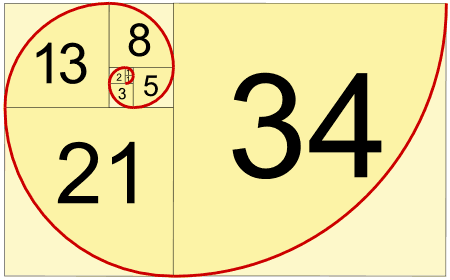
  • Is it possible to produce a spiral like the one the Fibonacci Sequence produces that could possibly be mirrored in nature?
This is the time to use your creativity and see where it takes you. Who knows? Maybe you could tell a story like Fibonacci did about rabbits that leads to a powerful new number pattern. And then, just maybe, in another thousand years (or less) math students of the future could find themselves studying the (Your Name Here) Sequence.

Good luck - good math!

-Tom Robinson
Pascal's Triangle (Stay tuned for Pascal's Orchard!)
Image credit: MtDouglas.ca

Here is a link to a Math Is Fun site that explores other number sequences you may be interested in. They are not Fibonacci sequences, but might be fun to discover on your own.

Wednesday, October 8, 2014

Lucas Numbers

I came across this video by chance, though I love the Numberphile guys (and gals) and their work. It explains the concept of Lucas numbers, which are directly related to Fibonacci numbers, but are pretty intriguing in an unexpected way. I won't spoil the fun, but do take some time to watch - you will be surprised by what you learn, though I do take exception to his claim that Lucas Numbers are actually better than Fibonacci. Call me biased...

Lucas Numbers - from Numberphile's YouTube Channel 
featuring Matt Parker


Lesson #5 - Creating Integers From Fibonacci numbers


Objective: Students will use Fibonacci numbers and the four arithmetic operations to produce integer values from 1-20, 1-50, 1-100.

Photo credit:
DevCentral
Task: Using only Fibonacci Sequence numbers and the four arithmetic operations (addition, subtraction, multiplication and division) produce each integer value from 1-20. Older students may be challenged to produce numbers through 50, or even 100.

Example: The number 10 may be produced in the following ways using Fibonacci numbers:
5+5
8+2
Photo credit:
MathIsFun.com
13 - 3

The number 17 may be produced by doing the following:
13 + 5 - 1
8*3-13 + 3*2


  • How many different ways can you find to make each target number?
  • Which numbers can you find using only addition?
  • Which numbers can you find using only addition and subtraction without repeating any numbers?
  • Which numbers can you find using all four operations?

Friday, September 12, 2014

Lesson #4 - Find a Rectangle


Rectangles are all around us. There are posters and framed photo on our walls, highway and roadside signs, buildings, computer monitors and smartphones, and the list goes on and on.

But some of these rectangles seem to look more, well, RIGHT, than others. And sometimes it's hard to tell why they do. Consider the following two rectangles:

Photo credit:
American Pools Ipswitch
Photo credit:
Creative Beacon.com
       
Does one look 'better' than the other? Why do you find yourself drawn to that one? Chances are, it's because of its dimensions, which likely are very close to the Golden Ratio, found in the Fibonacci Sequence.

Lesson #4 - Find a Rectangle

Objective: Students will identify rectangles whose dimensions closely match 'phi', or the Golden Ratio, which is approximately, 1.618.

Task: Look around your house, your community, or larger town and identify five rectangles which seem to match the dimensions of the Golden Ratio. That is, their lengths are approximately 1.618 times their widths.

Take a photo of the rectangle for your collection.

If possible, use a measuring device to measure the actual length and width of each rectangle. If the rectangle is located on private property, be sure to ask permission before taking measurements. Compare the ratio of your rectangle's length to its width to the Golden Ratio. How close were your values?

Sunday, August 31, 2014

Lesson #3 - Find a Flower


Sorry for the delay. I was working in Italy this past month, and was fortunate enough to spend time in Fibonacci's home town (Pisa). In fact, here is a photo of me at the top of the Leaning Tower with my friends, Chris, Bern, and Mike, the coaching staff of the University of Pennsylvania women's basketball team.
Standing on top of the Leaning Tower of Pisa, home of Leonardo Pisano,
better known as Fibonacci (that is, Pisa was his home, not the tower!)
That's me on the leftAugust 2014
Lesson #3 - Find a Flower

Objective: Students will locate and pick flowers with petals that represent one of the Fibonacci numbers.

Task: Look around your house, your school, or your local community for flowers with petals. Make sure you are allowed to pick the flowers. If you are not sure, just take a picture of it. If you are completing this task at at time of year in which there are no flowers blooming, look for plants or trees with leaves if possible.

Count the petals and try to find one example of each of the first few Fibonacci numbers:

1, 1, 2, 3, 5, 8, 13...

After you have selected your flowers, present them to your teacher. Finally, rate yourself using the scale below:

1 flower: Way to go - you found one!
2 flowers: Excellent! Keep your eyes open for more Fibonacci numbers around you.
3 flowers: Outstanding! Fibonacci would be proud of you!
4 or more flowers: Incredible! You might be the next Fibonacci!