Site Visits

Thursday, January 22, 2015

Children's Book Week - May 4-10, 2015


I am pleased to announce the 96th annual Children's Book Week which will take place during the first full week of May. During this event, events will be hosted across the country in all 50 states with a focus on encouraging children to engage in reading and exploring new books. 

Look for events near you by visiting the CBW Web site. Beginning in March, children can vote for their favorite new books of the year. So encourage any kids you know to get out, read, and vote! And starting in April, be sure to have them read and vote for Fibonacci Zoo! Voting is currently closed, but you can visit this site for more information. 

I hope to be hosting an event in Chelan, WA, either at the Chelan Public Library or a Riverwalk Books as part of this year's celebration. Stay tuned for more information.


Thursday, January 15, 2015

Fibonacci Zoetropes

Say what? Yes, zoetropes. And I have to confess. Before today, I had never heard that term before. But now that I have and have seen this video, I can't stop thinking about them.

What you are about to watch is the remarkable work of one John Edmark. John printed a number of 3D sculptures, each in its own way reflecting the Fibonacci Sequence. In one of the links, you will see how the 'golden angle' shows up in these pieces of art.

But the art isn't the real art here. He started them spinning, some up to 550 rpm, and then captured their spins with a stop-action video camera with a very fast shutter speed (1/2000 of a second). The combination of spin and shutter speeds produces a strobe-like effect, and the results are breathtaking.

Please take a few minutes to enjoy John's video work, and then follow the links to see some of the behind the scenes details of all that went into this production. Fibonacci. It never stops.


Try these links for the story behind this incredible video:


Sunday, December 14, 2014

Consecutive Dates

Photo credit: USA Today
Well, a big consecutive date is now in the past. 12/13/14 has come and gone, and now we look ahead to the next major milestone of this kind. Most people note that because 13/14/15 isn't going to be possible next year, and indeed none of the integers that follow will ever be possible (as December is the 12th month), the next major such date will be 01/02/03, in 2103, a little over 88 years from now.


Photo credit:
KeepCalm-a-Matic
But never fear, Fibonacci is here! We actually have a Fibonacci date coming up in just under seven years! First let's look back at the last Fibonacci date. It would have been 05/08/13, or May 8th of last year. Our European friends would even argue that where they live, that date would have been August 5 of 2013, even more recent.


So when will the next Fibonacci date be? On August 13, 2021, the date will be 08/13/21. Sorry, Europeans. No such date for you. So make your plans early, and prepare for the last Fibonacci date celebration of the century!

Sunday, November 23, 2014

Happy Fibonacci Day!

I want to wish each and every one of you a very Happy Fibonacci Day, today, November 23. Why, you ask? The Fibonacci Sequence is a pattern of numbers that begins 1, 1, 2, 3, ... The key to the sqeuence is that you simply add any two consecutive number to produce the next number. Today, November 23, is 11/23 and for that reason we celebrate this powerful pattern.

Take a look through this blog for more about the Fibonacci Sequence, and be sure to look for my new book Fibonacci Zoo, due on shelves in April 2015!

Saturday, October 18, 2014

Lesson #6 - Make Your Own Fibonacci Sequence

Ok, we have come to the final lesson in this journey. Your final task is a little more open-ended, but should be a fun one. I would like you to come up with your own Fibonacci Sequence.

A Triangular Number Sequence
Imagecredit: Math is Fun.com
I know what your first reaction may be: How is that possible? Isn't there only one Fibonacci Sequence?

And indeed, technically you may be correct. But think for a second about what makes this sequence so simple. All you do is add two consecutive numbers in the sequence to find the next number. That's pretty simple, right?

The Fibonacci Sequence (the real one) begins with the numbers 1 and 1. From there, 1+ 1 =2, 1 + 2 = 3, and so on.
A Pentagonal Number Sequence
Image credit: astarmathsandphysics.uk

What I would like you to do is to pick two different numbers to start your sequence. They can be the same numbe
r twice, just like Fibonacci did. Something like 2, 2, perhaps. Or they can be different numbers. Maybe 2, 3. Or you could pick two totally outlandish numbers, like -5 and 7.

It doesn't matter which two you pick. What's most important is that you figure out how to produce the next values in the sequence and then go exploring to see what the sequence holds in store.

Some questions to ponder:
A Hexagonal Number Sequence, of sorts
Imagecredit: drking.org.ca

  • What common ratio does your sequence eventually lead to? The Fibonacci Sequence leads to 'phi', or approximately 1.618, which is often called the Golden Ratio. Does your sequence approach a similarly small value? Is it close to 'phi'?
  • Is there any way to create a sequence of numbers that eventually matches the original Fibonacci numbers, if not all, at least some? 
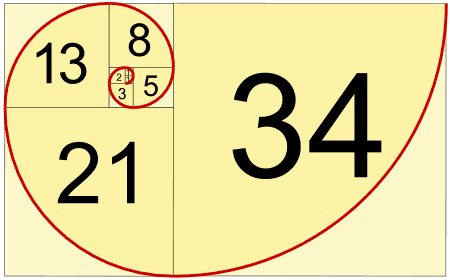
  • Is it possible to produce a spiral like the one the Fibonacci Sequence produces that could possibly be mirrored in nature?
This is the time to use your creativity and see where it takes you. Who knows? Maybe you could tell a story like Fibonacci did about rabbits that leads to a powerful new number pattern. And then, just maybe, in another thousand years (or less) math students of the future could find themselves studying the (Your Name Here) Sequence.

Good luck - good math!

-Tom Robinson
Pascal's Triangle (Stay tuned for Pascal's Orchard!)
Image credit: MtDouglas.ca

Here is a link to a Math Is Fun site that explores other number sequences you may be interested in. They are not Fibonacci sequences, but might be fun to discover on your own.

Wednesday, October 8, 2014

Lucas Numbers

I came across this video by chance, though I love the Numberphile guys (and gals) and their work. It explains the concept of Lucas numbers, which are directly related to Fibonacci numbers, but are pretty intriguing in an unexpected way. I won't spoil the fun, but do take some time to watch - you will be surprised by what you learn, though I do take exception to his claim that Lucas Numbers are actually better than Fibonacci. Call me biased...

Lucas Numbers - from Numberphile's YouTube Channel 
featuring Matt Parker


Lesson #5 - Creating Integers From Fibonacci numbers


Objective: Students will use Fibonacci numbers and the four arithmetic operations to produce integer values from 1-20, 1-50, 1-100.

Photo credit:
DevCentral
Task: Using only Fibonacci Sequence numbers and the four arithmetic operations (addition, subtraction, multiplication and division) produce each integer value from 1-20. Older students may be challenged to produce numbers through 50, or even 100.

Example: The number 10 may be produced in the following ways using Fibonacci numbers:
5+5
8+2
Photo credit:
MathIsFun.com
13 - 3

The number 17 may be produced by doing the following:
13 + 5 - 1
8*3-13 + 3*2


  • How many different ways can you find to make each target number?
  • Which numbers can you find using only addition?
  • Which numbers can you find using only addition and subtraction without repeating any numbers?
  • Which numbers can you find using all four operations?